Assumption & Experiment Board
Surface the assumptions an idea depends on, test the riskiest ones cheaply, and decide on evidence.
Where it fitsStage 3 of 7 · Design: What must the organisation and the offer look like?
What it is
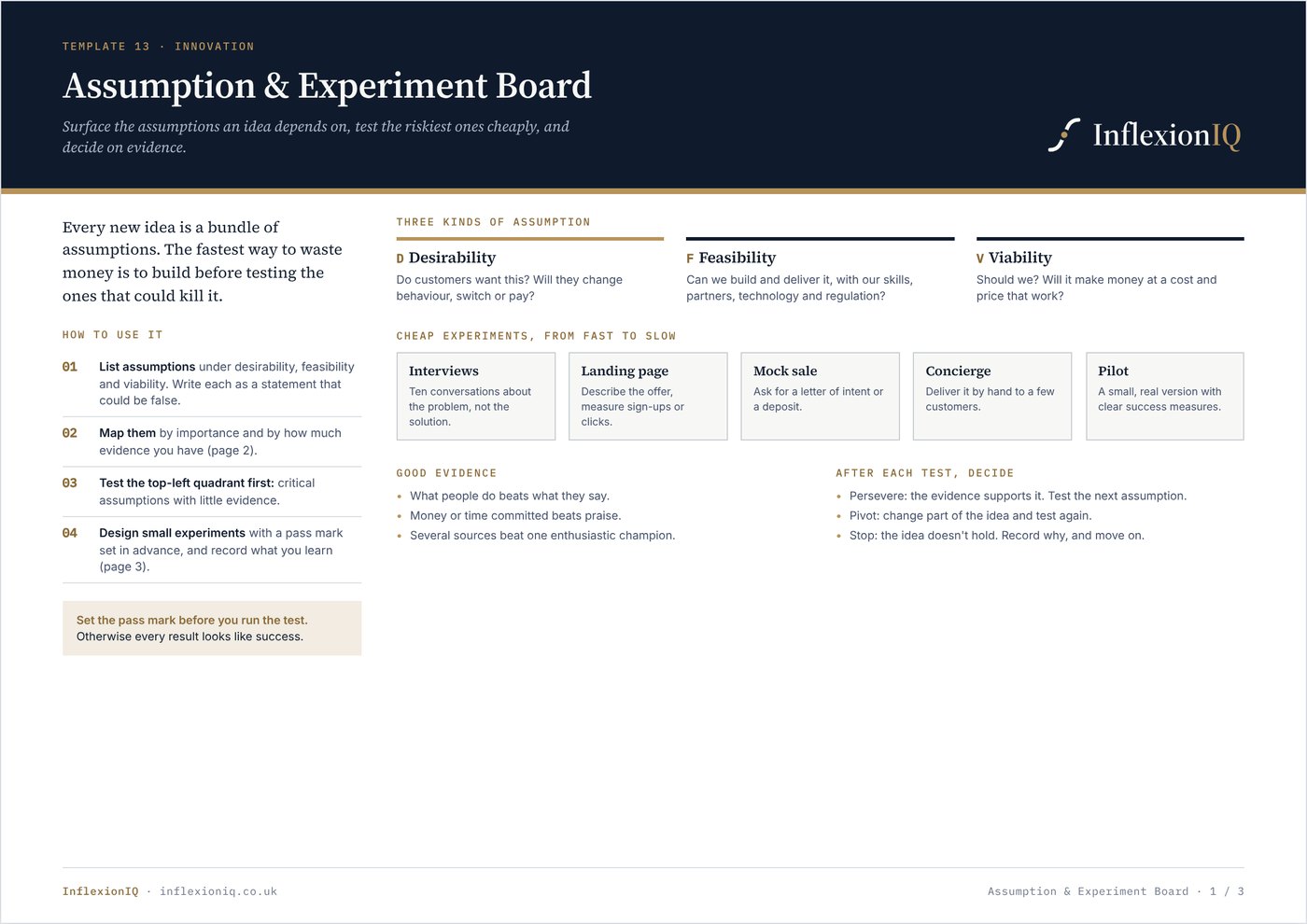
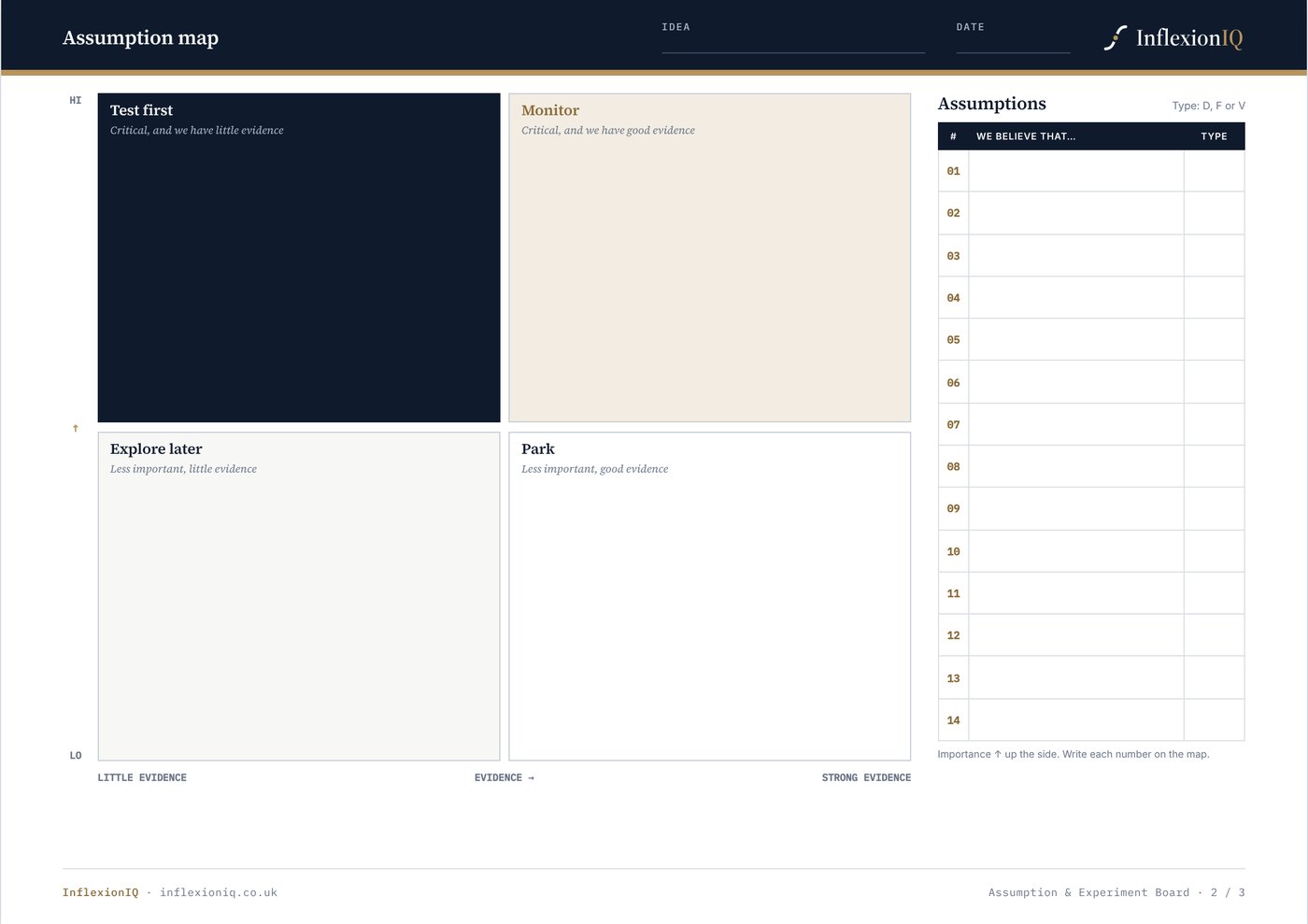
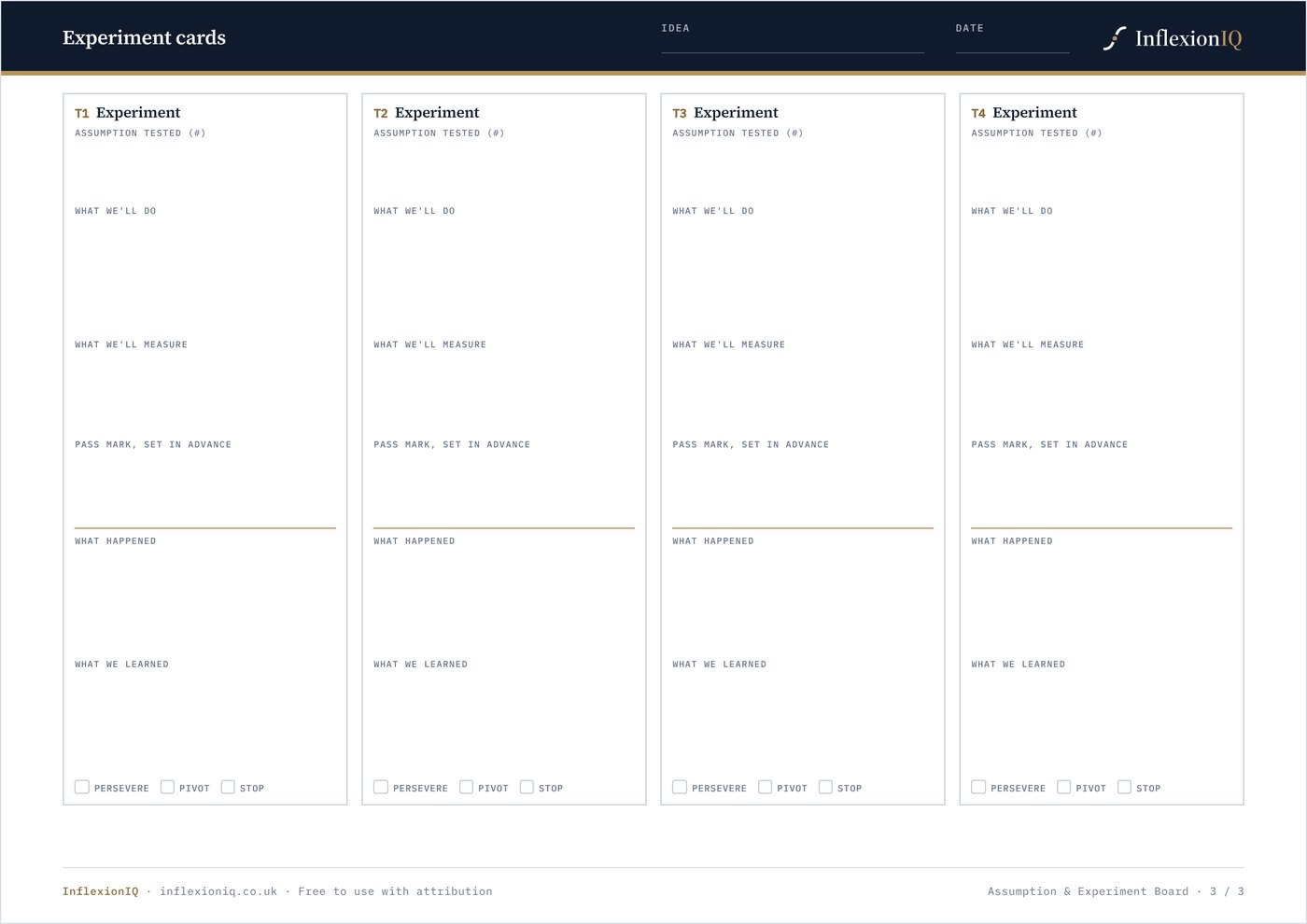
A board for turning ideas into evidence. The guide explains desirability, feasibility and viability assumptions and how to rank them. The assumption map plots each one by importance and evidence. Experiment cards record the assumption, the test, the measure, a pass mark set in advance, what happened and the decision: persevere, pivot or stop.
Why use it
New ideas fail when teams build on assumptions nobody tested. A short loop of cheap experiments replaces opinion with evidence, and gives leaders a fair basis to fund, pivot or stop.
How to use it
- List every assumption the idea depends on, under desirability, feasibility and viability.
- Plot each one on the map by how important it is and how much evidence you already have.
- Start with the top-left: critical assumptions with little evidence.
- Design the cheapest, fastest test for each, and set the pass mark before the test starts.
- Record what happened and decide: persevere, pivot or stop.
When it helps
- Before funding a new product, service or venture
- After an ideation session, to decide which ideas to test
- When a team is debating opinions instead of evidence
- Preparing for a stage-gate funding decision
What is inside
- A guide to the three types of assumption and how to rank them
- An importance versus evidence assumption map
- Experiment cards with test, measure and a pass mark set in advance
- Space to record what happened and decide to persevere, pivot or stop
Worked example
AI document checks rested on one critical assumption with little evidence.
| Assumption | AI can extract income figures from payslips and bank statements with at least 95% accuracy. |
|---|---|
| Test | Run the AI on 500 past cases in a secure test environment, and compare it with what underwriters recorded. |
| Pass mark | 95% of figures correct, set before the test began. |
| Result | 97% on payslips. Only 88% on bank statements, because formats vary so much. |
| Decision | Persevere for payslips. Pivot for bank statements: test open banking data instead. |
What happened next. The test cost £25k and four weeks. It stopped the lender betting the whole programme on bank-statement reading.
Preview
Questions
Which assumptions should you test first?
The ones that are both important (the idea fails if they are wrong) and least supported by evidence. Plot them on an importance versus evidence grid and start in the top-left.
What makes a good experiment?
A clear hypothesis, a measurable signal, a pass mark agreed before the test runs, and the cheapest, fastest way to get real evidence. Decide what you will do if it passes or fails before you start.
Rate and review
How useful was this template?
Your rating and comments help me improve the template and decide what to build next. It takes less than a minute.
Thank you.
Your feedback has been sent. If you have got another minute, share the template with someone who'd find it useful.
More templates
All templates →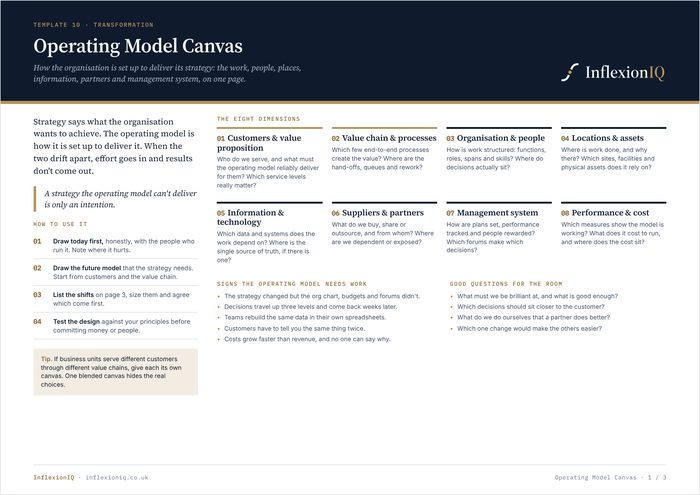
Operating Model Canvas
How the organisation is set up to deliver its strategy, from the work and people to places, information, partners and management, on one page. PowerPointPDFView and download →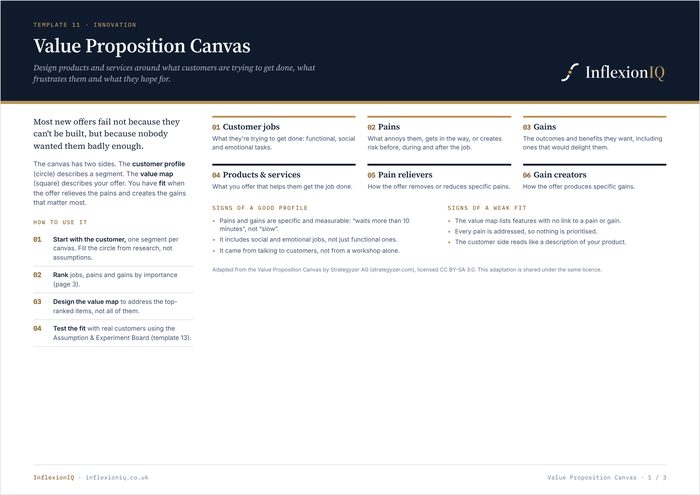
Value Proposition Canvas
Design products and services around what customers are trying to get done, what frustrates them and what they hope for. PowerPointPDFView and download →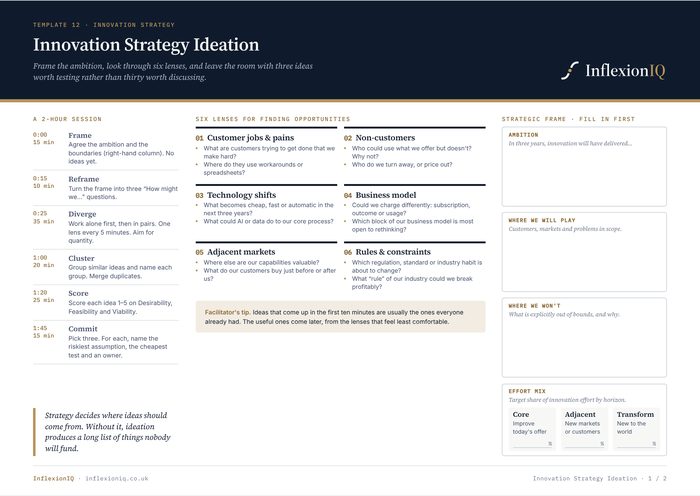
Innovation Strategy Ideation
Frame the ambition, look through six lenses, and leave the room with three ideas worth testing. PowerPointPDFView and download →Need something different? Request a template →